SunSpec is stepping into an important phase of global and domestic regulatory engagement. This month, the SunSpec Alliance is submitting draft comments to the Bureau of Indian Standards (BIS) in response to India’s proposed IS 18968 specification, its national adaptation of IEEE 1547. Our goal is to support technical harmonization, reinforce cybersecurity expectations, and share lessons learned from over a decade of DER integration experience in North America. India’s clean energy market is growing fast, and we believe SunSpec standards can serve as a stable foundation for scale, safety, and interoperability.
Closer to home, we also prepared formal comments for the Arizona Corporation Commission’s data center rate docket. As hyperscale loads reshape the power landscape, SunSpec is advocating for consistent interconnection frameworks, cybersecurity-enforced telemetry, and IEEE 1547 compliance to ensure that data centers function as reliable grid assets.
The impact is clear: when governments and grid operators adopt common standards, we reduce integration friction, lower compliance costs, and open the door to innovation. Markets reward clarity, and SunSpec is here to deliver it.
SunSpec and its members are also achieving notable progress in standards development through active participation in the SunSpec Modbus and SunSpec IEEE 2030.5 Test Procedures Work Groups. On the SunSpec Modbus front, we are nearing the TEST status and public review phase for the Modbus TLS/Security Compliance and Test Criteria Specifications. Additionally, significant strides are being made in developing the SunSpec Modbus Client Compliance and Test Criteria as well as new SunSpec Modbus Grid-forming Models.
In parallel, the SunSpec IEEE 2030.5 Test Procedures Work Group is advancing efforts on both CSIP Test Procedures and, soon, the IEEE 2030.5 Compliance Profile and Test Procedures for SAE J3072 V2G AC. We invite all interested parties to get involved as Members of the Alliance. Members can sign up for these impactful initiatives through the SunSpec Member Portal. If you’re not yet a member, now is a great time to join the Alliance and contribute to the future of our industry.
In addition to these initiatives, I would like to make an exciting announcement. At SunSpec, we believe that investing in people is the surest way to accelerate our mission. I’m proud to share that two key members of our team, Sam Reid and Erin Mahan, have been promoted to Vice President roles.
Sam Reid steps into the role of Vice President of Content and Operations, where he leads our communications strategy and business efforts with precision. His leadership ensures our internal operations run as seamlessly as SunSpec’s interoperability and communication standards.
Erin Mahan now serves as Vice President of Membership and Regulatory Affairs. She brings a collaborative spirit to our work with members, utilities, and regulators, ensuring that SunSpec remains a trusted partner to all.
Both Erin and Sam embody the values that make SunSpec unique: mission-driven leadership, technical fluency, and a bias toward action. I’m excited to continue building with them as we take SunSpec’s impact to the next level.
As we expand our global policy engagement and elevate leadership within our organization, SunSpec remains committed to building a secure, standards-driven energy future. Our efforts in India and Arizona reflect a broader strategy focused on collaboration, technical integrity, and practical solutions for grid modernization. With Sam and Erin taking on new leadership roles, we are strengthening our ability to scale, deepen our partnerships, and deliver lasting value to our members and the broader DER ecosystem. SunSpec will continue to lead with clarity, purpose, and a commitment to accelerating the clean energy transition.
Dylan Tansy
Executive Director
SunSpec Alliance

The latest SunSpec webinar, Unlocking Modbus: Accelerate Adoption with SunSpec DevKit and Open-Source Tools, brought together leading open-source technologists to address one of the solar industry’s most persistent challenges: transforming raw Modbus data into usable, secure, and interoperable information streams. Niels Basjes, a cybersecurity innovator with Bol., presented the Modbus Schema Toolkit—a dynamic solution that generates machine-readable schemas to standardize device communications across solar and DER systems. Peter Grace, DevOps Engineer at StackBlitz, introduced Sunspec RS and Sunspec Gateway, two MIT-licensed tools built in Rust that simplify Modbus TCP integration and enable seamless data streaming into MQTT platforms like Home Assistant.
Vish Ganti, President and COO of DER Security Corp, unveiled the upcoming SunSpec DevKit, which unifies these open-source tools into a single platform for schema querying, parameter adjustments, and model exports. The webinar also marked the launch of the new EIoT Open-Source Lab—funded by the Astera Institute and hosted at Port Labs—to foster collaboration around DER development. With the SunSpec Modbus Workgroup advancing Modbus TLS compliance and security standards, the session emphasized a growing industry shift toward secure, open, and scalable tools for DER integration.
Missed the session or looking to revisit key moments? Access the webinar resources below:
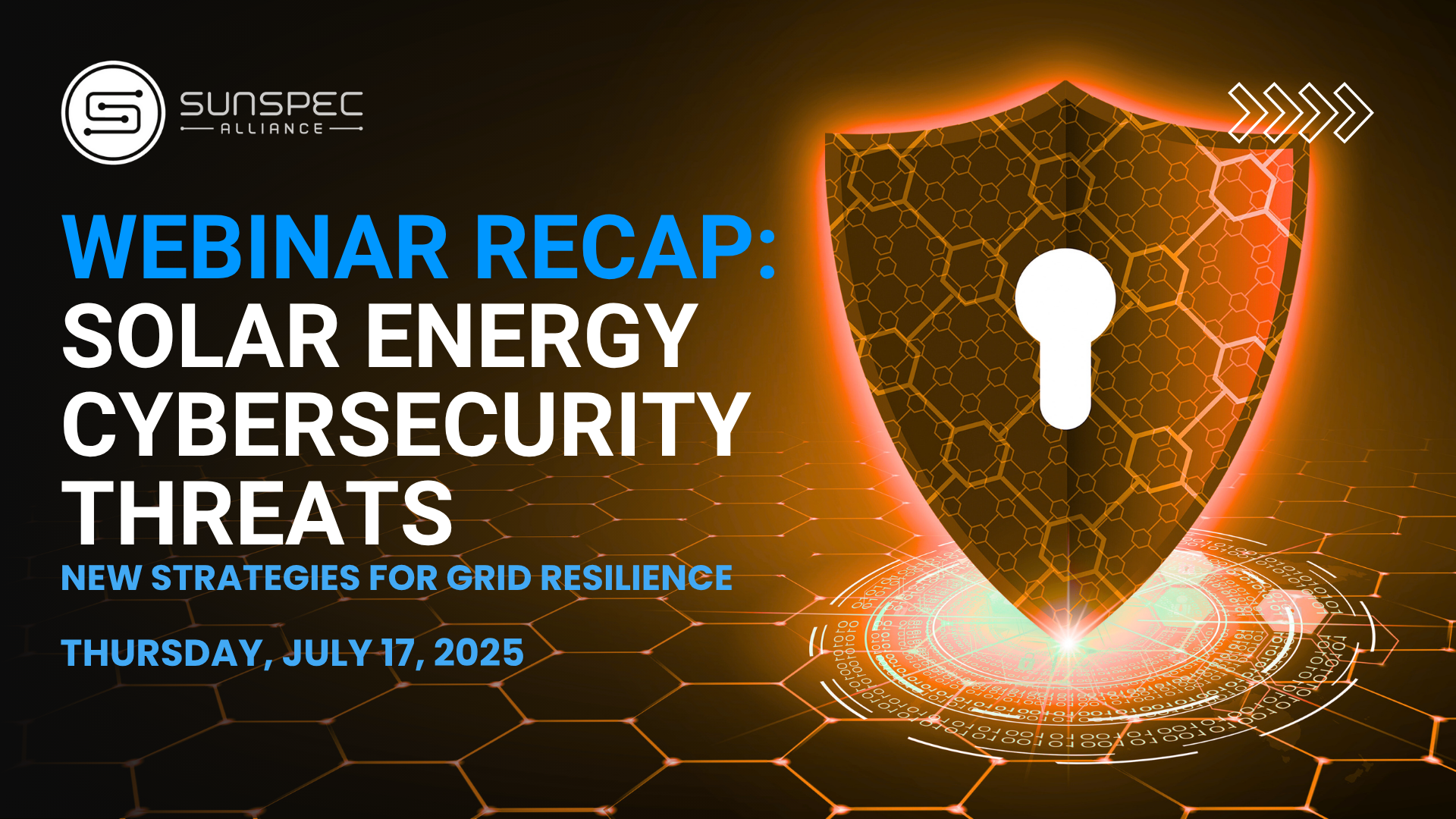
On July 17, 2025, SunSpec Alliance hosted a critical webinar addressing cybersecurity threats facing solar energy systems and exploring innovative strategies for enhancing grid resilience. Moderated by Dylan Tansy, Executive Director of the SunSpec Alliance, the session featured insights from industry experts including Dr. Paul Stockton, Jay Johnson (CTO of DERSec), and Tom Tansy (CEO of DERSec). Discussions emphasized the substantial cybersecurity vulnerabilities affecting nearly half of global solar production, exploring real-world scenarios involving compromised cloud infrastructures, insecure APIs, and malicious firmware updates. Experts highlighted essential cybersecurity certifications and regulatory frameworks needed to address these threats, such as NIST 2 and the Cyber Resilience Act.
Further discussions centered around leveraging Distributed Energy Resources (DERs) to bolster national security, emphasizing the benefits of microgrids, decentralized power restoration, and strategic dispersion of critical resources. The webinar also tackled supply chain vulnerabilities, particularly the risks associated with dependence on Chinese-manufactured solar equipment, advocating phased implementation of mandatory cybersecurity standards through product whitelisting and interconnection agreements. Panelists stressed shared responsibility among utilities, manufacturers, and end-users, urging comprehensive defense strategies to protect communication networks, manage emerging AI-driven DER management systems, and mitigate threats from rogue devices.
Missed the session or looking to revisit key moments? Access the webinar resources below:
July 2025 News Highlights:
1. Solar Curtailment Reduces in California Thanks to Battery Integration
CAISO data shows solar curtailment down from 13% to 11.5% in early 2025, even as solar generation increased by approximately 18% year-over-year. Energy storage and DER assets are clearly helping improve grid dispatch flexibility and resource utilization.
2. Utilities Embrace VPPs to Enhance Grid Flexibility
Industry thought leadership underscores VPPs as a critical strategy for utilities to manage rising DER complexity. By aggregating DERs—solar, storage, smart devices—VPPs are unlocking flexibility to respond to peak demand while reducing capital risk and future-proofing grid infrastructure.
3. Q2 2025 DER Policy Snapshot Shows Growing State Engagement
The SEPA/N.C. Clean Energy Technology Center Q2 report highlights broad policy momentum across state regulators and utilities. From Arizona’s BYOD pilot to California’s Demand Side Grid Support program, state PE integration frameworks are accelerating DER aggregation opportunities.
4. DOE Reaffirms VPP Growth—U.S. Capacity Now ~33 GW
The U.S. Department of Energy’s VPP Liftoff update confirms that nearly 33 GW of VPP capacity is already operational or in development. DOE emphasizes strategies like auto-enrollment, equity-focused adoption, operational standardization, and seamless integration into utility planning to reach 80–160 GW by 2030.
5. Utility‑Led DER Models Offer Speed & Affordability
New analyses demonstrate that utility-led Virtual Power Plant deployment—such as Distributed Capacity Procurement programs in Minnesota—can deliver DER capacity faster and more cost-effectively than traditional centralized infrastructure. These models also support greater equitable customer participation without upfront investment.
Why this matters:
You’re Getting More Out of Solar
California’s reduced curtailment means less clean energy is being wasted—and more of it is powering homes, businesses, and EVs. If you’re a solar customer, this translates to better grid performance and stronger system value.DERs Are Becoming Grid Assets—And That Includes Yours
As utilities and aggregators embrace Virtual Power Plants, technologies like home batteries, EVs, and smart devices are now playing a real role in supporting grid reliability. That means you can actively contribute to grid stability—and in many cases, get paid for it.States Are Creating New Opportunities to Participate
From Arizona’s BYOD expansion to California’s Demand Side Grid Support program, states are launching policies that reward flexible energy use. These programs lower barriers to entry, open up new revenue streams, and make it easier for consumers and small businesses to join the energy transition.Virtual Power Plants Are Fast, Affordable, and Scalable
New research shows that VPPs can be deployed in 6–12 months at lower cost than traditional power plants. For communities, that means quicker access to reliable power solutions without waiting years for new infrastructure.The Clean Energy Shift Is No Longer Theoretical
With 33 GW of VPP capacity already online or in development—and growing—this isn’t a future concept. It’s a working solution being scaled across the country, with room for anyone with solar, storage, or smart devices to be part of it.