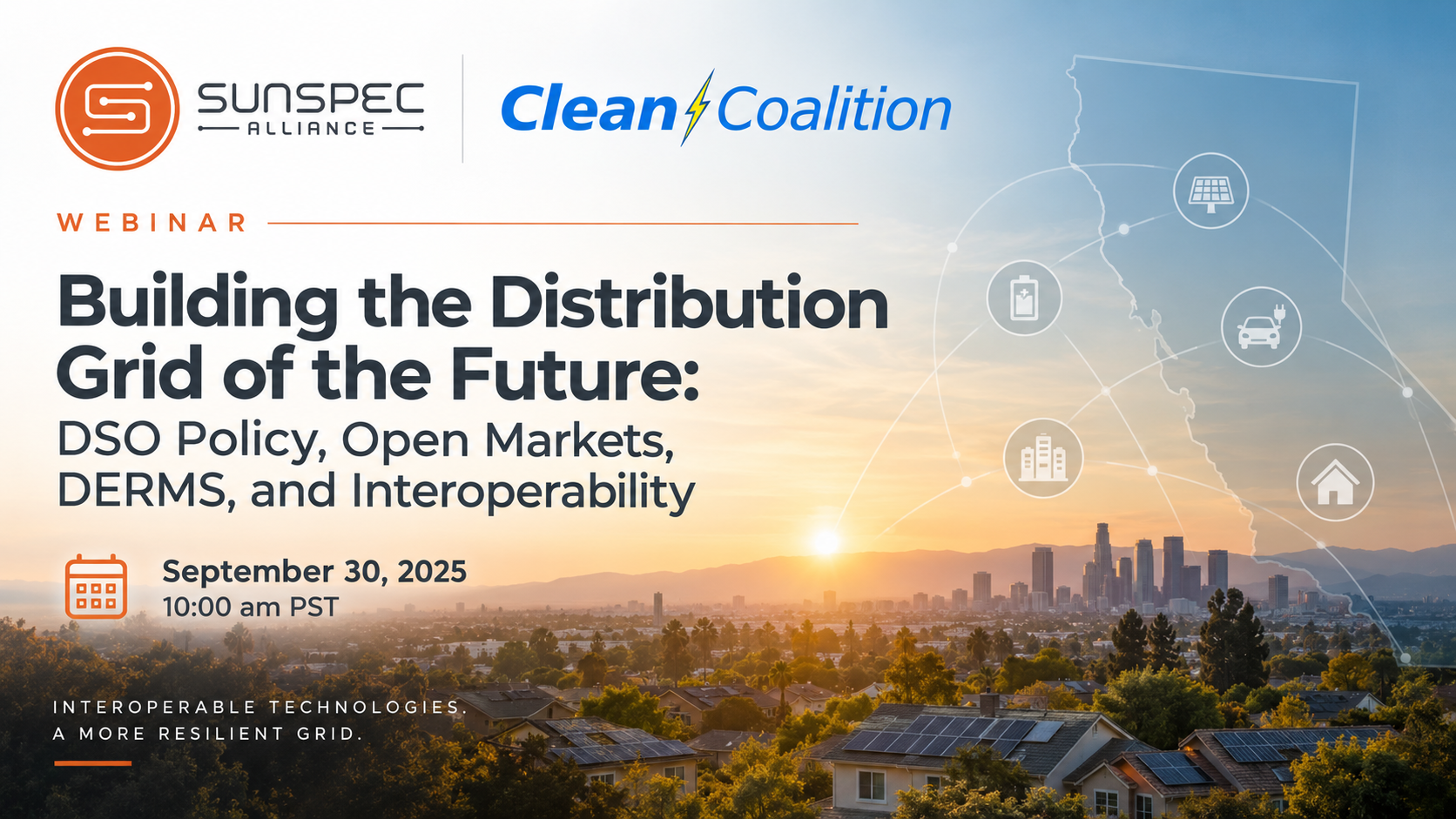
SunSpec Alliance and Clean Coalition will convene policy, technology, and market experts for a webinar examining how California can build a distribution system operator framework that unlocks the full capabilities of distributed energy resources (DERs).
As electricity demand grows and increasing numbers of solar, energy storage, electric vehicles, flexible loads, and other DERs connect to the grid, California must determine how these resources will be coordinated, valued, and compensated. A distribution system operator, or DSO, can help balance local supply and demand, address grid constraints, and procure services from distributed resources before defaulting to additional conventional infrastructure.
Realizing that potential will require more than deploying new utility control systems. An effective framework must establish interoperable communications, clearly define the respective roles of grid-level and edge DER management systems, provide open and nondiscriminatory access to distribution markets, and enable distributed resources to earn compensation for the distinct services they provide.
This webinar will explore how policy, market mechanisms, and technical standards can work together to create an open, flexible, and resilient distribution grid.
This webinar will cover:
- The emerging role of a distribution system operator: How a DSO can balance the distribution system locally, identify grid needs, coordinate distributed resources, and manage interactions with the transmission system.
- Grid DERMS and edge DERMS: How utility grid-management platforms can coordinate with aggregators, community choice aggregators, technology providers, and customer-facing edge DERMS without requiring the utility to directly control every device.
- Open-access distribution markets: How transparent eligibility, procurement, pricing, performance, and settlement rules can allow qualified distributed resources and aggregators to compete to meet identified grid needs.
- Building a bankable DER value stack: How distributed resources can provide and receive compensation for energy, capacity, load flexibility, voltage support, congestion relief, infrastructure deferral, resilience, and other locational and operational services without improperly double-counting value.
- IEEE 2030.5 and the Common Smart Inverter Profile: How communications and interoperability standards can support secure, scalable coordination between utilities, aggregators, DERMS platforms, and distributed devices, including the importance of fully incorporating IEEE 2030.5 into CSIP implementation and testing.
- Bring-your-own-capacity arrangements for large loads: How data centers and other large-load customers could use onsite generation, storage, and flexible demand to limit grid impacts, accelerate service, and provide capacity or operational support.
- Resilience and Community Microgrids: How grid-forming resources, black-start capability, flexible loads, and progressively assembled DER portfolios can support outage mitigation and create a pathway toward community-scale resilience.