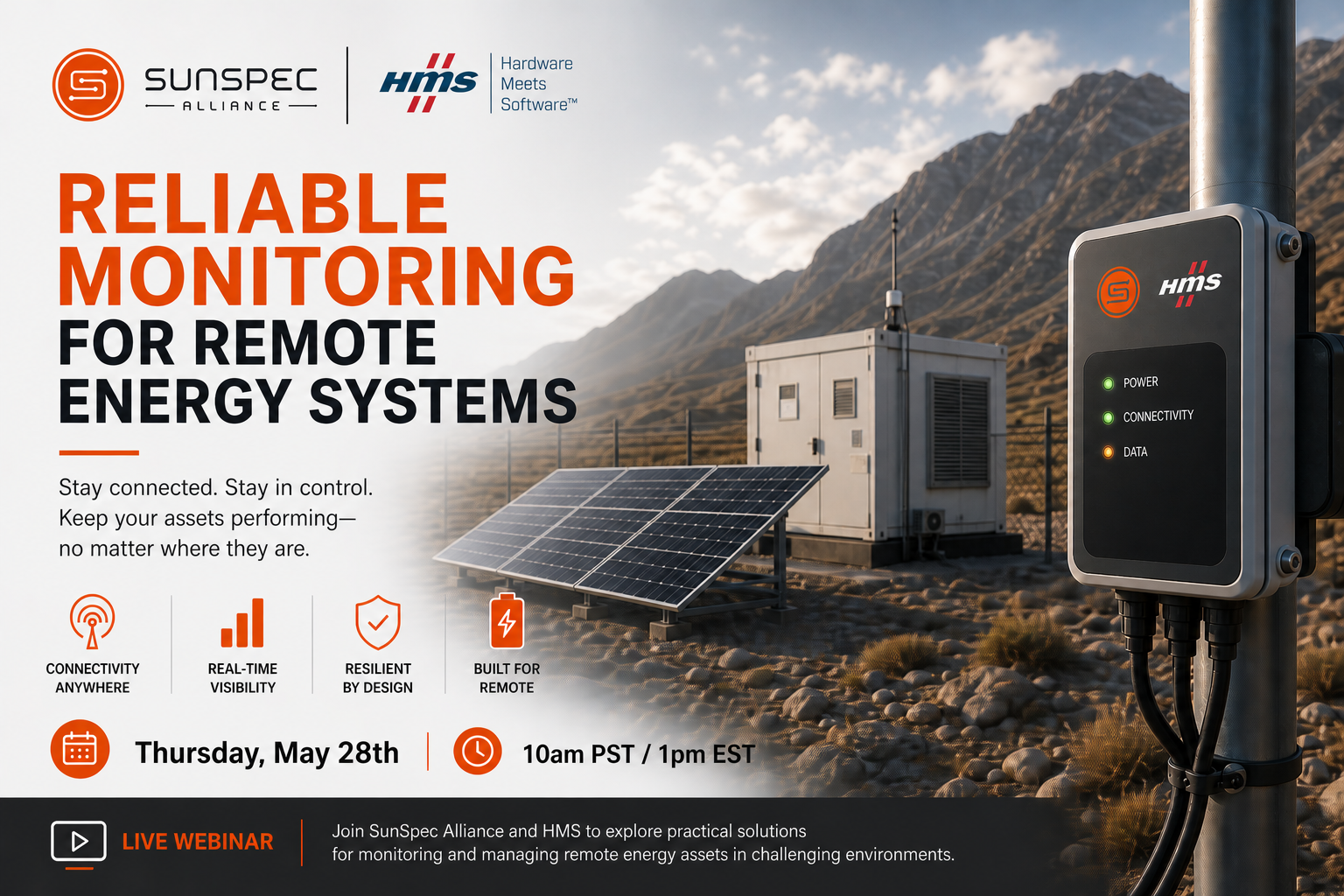
In this webinar, HMS Networks joined SunSpec Alliance to discuss the technologies, strategies, and challenges involved in reliably monitoring remote energy systems. As solar, battery storage, generators, and hybrid energy installations continue to expand into remote and off-grid environments, operators face increasing demands for reliable connectivity, efficient data management, and continuous system visibility.
Drawing on real-world deployments across the energy sector, HMS shared practical approaches for overcoming common challenges such as intermittent cellular connectivity, limited bandwidth, diverse communication protocols, and remote troubleshooting. The session explored how edge intelligence, local data storage, and protocol interoperability can help organizations improve reliability, reduce operating costs, and maintain access to critical system data even when communications are disrupted.
Topics covered included:
- Key challenges associated with monitoring remote and off-grid energy assets
- Best practices for managing connectivity over cellular networks
- The importance of local buffering and store-and-forward architectures to prevent data loss
- How edge intelligence can reduce bandwidth usage and operational costs
- Strategies for alarm management and remote troubleshooting
- Integrating diverse equipment and communication protocols into a unified monitoring architecture
- Ruggedized hardware requirements for harsh operating environments
- Protocol conversion and data aggregation across solar, battery, generator, and industrial systems
- HMS Networks’ implementation of SunSpec Modbus and support for standardized energy communications
- The evolving role of edge analytics and AI in remote energy applications
Whether you manage remote solar installations, battery energy storage systems, generators, microgrids, or other distributed energy assets, this webinar provides valuable insights into building resilient monitoring architectures that keep critical systems connected, visible, and operational.