Blog
August Newsletter

Standardization continues as an integral driver of the DER industry’s growth and is accelerating deployment around the globe. As nations adopt, deploy and interconnect standards-based grid codes, cybersecurity and protocol compliance unlock interoperability and enhance grid reliability and resilience. In the face of growing geopolitical uncertainty, leveraging cybersecurity and protocol standards pushes network-connected distributed energy generation from a potential vulnerability to a national security asset. This is the mission critical vision that unites the SunSpec Alliance, its ecosystem of members, and nations around the globe.
In July, India announced the deployment of 10 million new systems supported by IEEE 1547 and SunSpec Modbus. At the same time, the Arizona Corporation Commission sought input from the industry on how to address the energy demand of rapidly growing hyperscale loads such as AI and cloud computing data centers. These two developments are emblematic of what is happening everywhere, and DER remains the quickest and most cost-effective method to meet the exponential growth of demand.
Nation-states and corporations are not the only ones pushing the industry forward! SunSpec is also seeing strong engagement from individuals in the open-source community which is supporting commercial deployment and unlocking new revenue streams and business opportunities.
To support these efforts and learn how SunSpec standards are currently impacting the industry at all levels, please join us and our members in these key activities:
SunSpec at RE+ on September 8-11 in Las Vegas (discount code available, book a meeting the the team)
SunSpec at V2G Business, Policy & Technology Forum on October 21-23 in Detroit
Secure SunSpec Modbus Work Group on Wednesdays at 8:00am PT
SunSpec IEEE 2030.5 Test Procedures Work Group every other Thursday at 1:30pm PT
SunSpec IEEE 2030.5/SAE J3072 V2G-AC Profile Work Group every other Thursday at 8:00am PT
SunSpec at the California Public Utility Commission (CPUC), Smart Inverter Working Group (SIWG) on September 25 at 1:00pm PT
For a full calendar events and work group activities see here.
As we expand our global policy engagement and elevate leadership within our organization, SunSpec remains committed to building a secure, standards-driven energy future. Our efforts in India and Arizona, in public outreach & education at in-person events, and in our cutting edge standards development work groups reflect a broader strategy focused on collaboration, technical integrity, and practical solutions for grid modernization. SunSpec will continue to lead with clarity, purpose, and a commitment to accelerating the clean energy transition.
Dylan Tansy
Executive Director
SunSpec Alliance

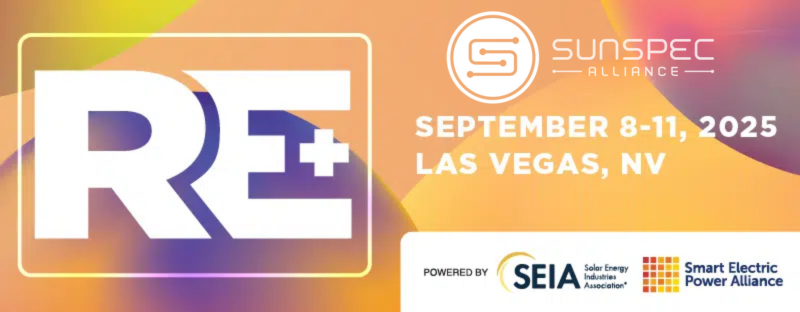
Use our exclusive discount code “25SUNSPEC15” to get 15% off admission
Join SunSpec leadership at RE+ in Las Vegas this September 8–11, where the energy industry’s brightest minds and most innovative companies come together to shape the future. From distributed energy resources to grid modernization, this is the place where ideas turn into action. Don’t miss your chance to connect, collaborate, and be part of the premier event driving the clean energy transition.
Executive Director Dylan Tansy and Vice President of Membership and Regulatory Affairs Erin Mahan will be attending. Click below to register now and book your meeting with our leadership team!

In a recent webinar hosted by ISGF, SunSpec Alliance, DER Security Corp, industry leaders and policymakers outlined India’s path to safely deploying 10 million rooftop solar systems under the PM Surya Ghar program. Speakers highlighted the adoption of IS-18968:2025, aligned with IEEE 1547-2018, making smart inverters and secure communications mandatory for all new DER connections.
The session emphasized SunSpec Modbus as the plug-and-play protocol for interoperability, enabling faster compliance testing, grid visibility, and integration with India’s digital energy stack. Critical discussions focused on cybersecurity risks, particularly in monitoring dongles, and the need for secure Modbus with mutual TLS to prevent large-scale vulnerabilities. Panelists from CEA, MNRE, Grid India, SunSpec, and DER Security agreed that interoperability, resiliency, and cybersecurity must be foundational to scaling rooftop solar, unlocking new market value streams while ensuring grid reliability.
Missed the session or looking to revisit key moments? Access the webinar recording below:
August 2025 News Highlights:
1. Virtual Power Plants Deliver in Real World California Test
A July 29 home battery VPP trial in San Jose, orchestrated by Sunrun, rallied more than 100,000 households to contribute 535 MW of collective power. That was enough to offset nearly half of San Francisco’s peak load and showcased the dispatchability and scale of customer sited DERs in action.
2. California’s VPP Program at Risk, Funding Could Save Grid and Customers Billions
New analysis of California’s Demand Side Grid Support program reveals that preserving funding could save utility customers between 28 million and 206 million dollars over the next four years. The program, which pays solar and battery owners to dispatch during peak demand, faces potential cuts unless legislative action restores support from the state’s Greenhouse Gas Reduction Fund.
3. U.S. Continues Record Solar Construction, Clean Energy Leading Power Additions
The U.S. is on pace for a record year of solar additions. About 12 GW came online during the first half of 2025, with another 21 GW expected by year end. Clean energy, dominated by solar, batteries, and wind, now represents approximately 93 percent of all new power capacity being built.
4. DOE Confirms VPPs Are Cost Effective and Scalable Grid Solutions
The Department of Energy’s Liftoff update highlights real world VPPs delivering more than 100 MW of peak shaving capacity with deployments in as little as six months and for under one million dollars upfront. The DOE states that VPPs now offer a cost advantage over utility scale batteries and natural gas peaker plants.
5. Batteries Reduce Solar Curtailment in California, Storage Gains Shift the Duck Curve
Through May 2025, battery storage helped lower California’s solar curtailment rate from 13 percent to 11.5 percent, despite an 18 percent increase in solar generation. Batteries are crucial in smoothing supply peaks and evening dynamics, though absolute curtailment rose slightly due to higher overall generation.
Why This Matters:
DERs Are No Longer Experiments, They Are Power Plants
The San Jose VPP demonstration proved that distributed assets like rooftop solar and home batteries can act as reliable, dispatchable capacity at the scale of hundreds of megawatts. This signals a new era where DERs are not supplemental, but central to grid planning. For customers, this means everyday investments in solar and storage directly contribute to energy security and resilience.
Policy Choices Have Real Financial Impact
California’s Demand Side Grid Support program highlights how well-structured policy can turn DERs into cost-saving tools for everyone. Cutting the program could increase costs for ratepayers and force utilities back toward expensive, centralized generation. Preserving and expanding these programs ensures that customer-sited clean energy is rewarded, and that grid services are delivered at the lowest possible cost.
The Clean Energy Build Out is Reaching Critical Mass
With solar making up the overwhelming majority of new capacity additions in 2025, the energy transition is no longer about incremental growth. It is now the primary driver of grid expansion. This has direct implications for DER integration standards, cybersecurity, and interoperability — areas where SunSpec members play a critical leadership role.
VPPs Are the Fastest, Most Affordable Path to Reliability
While traditional infrastructure projects can take years and billions of dollars, VPPs are proving they can be deployed in months, at a fraction of the cost, and with measurable benefits to reliability. The DOE’s confirmation of VPPs as cost-competitive solutions cements their role as a mainstream resource class rather than a niche pilot effort.
Storage is Transforming How Solar Interacts With the Grid
Batteries are reducing curtailment and shifting solar generation into evening hours, tackling the “duck curve” head-on. This evolution allows more clean energy to be utilized when it is most valuable, while reducing dependence on fossil peakers. For the industry, this is proof that integration of storage at scale is not just desirable, but essential to achieving carbon and reliability goals.